Uncategorized

United States Mexico War

The Mexican-American War (1846-1848) became the first armed conflict in the United States that took place abroad. As for Mexico, the war was a major disaster.

In the war, America faced Mexico which was politically divided and militarily unprepared to face US expansionist policies. At that time US President James K. Polk, believed the United States had a real destiny to rule the entire continent in the Pacific Ocean.
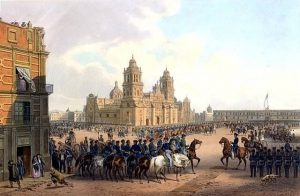
Fighting at the border along the Rio Grande marked the start of fierce fighting between the two countries. By the time the war ended, Mexico had lost about a third of its territory, including almost all of California, Utah, Nevada, Arizona, and New Mexico today.

Background of the Mexican-American War
In 1836, Texas gained its independence from Mexico. Initially, the United States refused to include it in the union, mainly because of political interests that opposed the addition of a new slave state.

However, the United States changed its mind and began the procedure of annexation (forced land acquisition to be united with its own land) after the election of Polk in 1844. He campaigned that Texas had to be re-annexed and the Oregon region must be reoccupied.

In addition to the two regions, Polk is also eyeing California, New Mexico and the rest that are now known as the US Southwest.

Polk had tried to buy these areas, but his offer of 30 million US dollars was rejected by Mexico. As a result of this rejection, he began provoking warfare by moving US troops into the disputed zone between the Rio Grande and the Nueces River that was previously recognized by both countries as part of the state of Coahuila, Mexico.

Mexican-American War Begins

Mexico is known to be very protective of its territory and even had time to warn America not to try to annex. Therefore, when US troops began to move into the Rio Grande region, the Mexican military immediately responded.

On April 25, 1846, the Mexican cavalry attacked a group of US troops commanded by General Zachary Taylor in the disputed zone. The attack killed about a dozen US troops.

They then surrounded the American fortress along the Rio Grande. Faced with the siege, Taylor called in reinforcements. With the help of superior rifles and artillery, they were able to defeat Mexican troops in the battles of Palo Alto and Resaca de la Palma.

After the battle, Polk told the US Congress that his patience had run out. He wants to defeat Mexico, before his neighbor begins to enter US territory. Two days later, on May 13, 1846, Congress formally declared war, despite opposition from some members of parliament, the war continued.

While on the other hand, no official declaration of war has ever come out of the Mexican Government.

United States Army Movement
At that time, only around 75,000 Mexicans lived north of the Rio Grande. As a result, US troops led by Colonel Stephen W. Kearny and Commodore Robert F. Stockton were able to conquer the land with minimal casualties. Taylor also experienced little difficulty when he took Monterrey in September.

In the midst of the fierce war, the former president and general of Mexico, Anonio Lopez de Santa Anna who was exiled in Cuba contacted Polk. Santa Anna assured Polk that if she were allowed to return to Mexico, she would end the war on favorable terms for the United States. Polk agreed with the idea, so he immediately sent a ship to bring Santa Anna from Cuba to Mexico.

When he arrived in Mexico, however, he became Polk’s new enemy by taking control of the Mexican army and leading him into battle. At the Battle of Buena Vista in February 1847, many Santa Anna troops were killed so he was forced to retreat.

Despite losing the battle, he actually took part in the Mexican presidential election the following month.

Meanwhile, US forces led by General Winfield Scott landed in Veracruz and took over the city. They then began marching towards Mexico City, which basically followed the same route that Hernán Cortés took when he attacked the Aztec empire.

The Mexicans fought back at Cerro Gordo and elsewhere, but were always defeated. In September 1847, Scott managed to surround Chapultepec Castle in the City of Mexico. During the siege, a group of military school cadets called niños héroes purportedly committed suicide rather than surrender.

End of the Mexico-United States War: Treaty of Guadalupe Hidalgo

Mexican guerrilla attacks on US forces continue, but the end of the war is visible. Santa Anna has resigned and the United States is waiting for a new government capable of negotiating. Thus the United States can be said to have won the war.

Finally, on February 2, 1848, the Treaty of Guadalupe Hidalgo was signed. This agreement concludes the Rio Grande (Formerly the Nueces River) as the new US-Mexico border. In addition, Mexico also acknowledged US annexation in Texas, and agreed to sell California and its remaining territory north of the Rio Grande for $ 15 million. Later the purchased territory became the states of California, New Mexico, Nevada, Utah, Arizona, Colorado, Wyoming, Oklahoma and Kansas.

War for 26 months must be paid handsomely. Of the 79,000 American troops who participated, 13,200 died during the war. Most are victims of diseases such as dysentery, yellow fever, malaria and smallpox. On the other hand, Mexico also lost many troops, most historians estimate that as many as 25,000 soldiers and civilians were killed.
america · oil · produce · US

The US States That Produce the Most Oil

The US States That Produce the Most Oil

A boom in oil production is profoundly changing the U.S. economy and impacting worldwide energy markets. As of 2015, 90% of U.S. oil production, excluding federal offshore drilling, comes from eight states: Texas, North Dakota, California, Alaska, New Mexico, Oklahoma, Colorado and Wyoming. The surge in U.S. output is due in large part to the wide use of horizontal hydraulic fracturing, or fracking, as new technologies give drillers access to some of the largest oil deposits in the world that were once too tight to exploit. Fracking is controversial as some believe the chemicals injected into the wells lead to extensive pollution of the water supply. Some also argue the unconventional horizontal drilling awakens dormant faults, causing earthquakes.

With domestic crude oil production averaging 9.4 million barrels a day over the first six months of 2015, the United States bypassed Russia and Saudi Arabia as the world’s largest producer of crude oil. This increased production is attracting manufacturers back to the U.S. Producing 90% of the energy it consumed in 2014, the U.S. imported less foreign oil every year from 2005 to 2015. Investors looking to get into the domestic energy markets may want to pay attention to shale drillers such as Exxon Mobil Corporation and Chesapeake Energy Corporation, which spent about $120 billion in 2014 in the U.S., more than double the amount spent five years earlier.

Texas

While other states have seen a boom in recent years, Texas is still the epicenter of the U.S. oil industry, with 27 operable refineries, more than any state. Texas produced 1.2 billion barrels of oil in 2014, which accounted for 36% of total U.S. output, and the state has almost one-third of all proven oil reserves with 10.5 billion barrels. If Texas were its own country, it would be the sixth-largest oil producer in the world. With increasing horizontal drilling of the state’s Eagle Ford Shale and Permian Basin, Texas is ramping up production, averaging 3.6 million barrels a day in 2015, up from 3.1 million in 2014. For those looking to invest in Texas, Exxon and Houston-based AT&T, Inc. are a good start.

North Dakota

The North Dakota oil boom is completely transforming the western portion of the state, which rests atop the Bakken Shale formation and the Williston Basin, two of the largest oil reserves in the world. Companies such as Whiting Petroleum Corporation, Continental Resources, Inc. and Hess Corporation are among the largest players in the region making these deposits profitable with the technological advancements in fracking. With oil production increasing by 1,000% between 2003 and 2015, North Dakota has 5.7 billion barrels of proven reserves and produced 397 million barrels in 2014. When combined with output from Texas, the two states provide half the entire U.S. oil output.

California

Excluding federal offshore areas, California ranked third in the nation in crude oil production with over 200 million barrels in 2014. Despite an overall decline in production since the mid-1980s, California has 2.9 billion in proven reserves, behind only Texas and North Dakota. California ranks third in the nation in petroleum refining capacity and accounts for more than one-tenth of the total U.S. capacity. To meet strict federal and state environmental regulations, California refineries are configured to produce cleaner fuels, and they often operate at or near maximum capacity because of the high demand for these petroleum products.

Alaska

While oil production has slowed in recent years in response to enhanced exploration and drilling in the plains, Alaska is still one of the largest oil-producing states with 181 million barrels of output and 2.9 billion barrels in reserve in 2014. The North Slope contains more than a dozen of the largest oil fields in the U.S. Although production has fallen to less than 300,000 barrels per day from its peak of 1.6 million barrels per day in 1988, the region is still one of the most profitable for ConocoPhillips Co.

Oklahoma

Production in Oklahoma has more than doubled since 2005 to more than 128 million barrels in 2014, pushing its way into the top five of the most productive oil-producing states. Oklahoma is the intersection of many of the largest national pipelines. The small city of Cushing is home to the world’s largest oil storage facility, where one-fifth of the country’s commercial crude oil is stored and where the primary U.S. oil price, known as West Texas Intermediate, is determined. Oklahoma City-based Continental Resources, Inc. has a leading presence in the Anadarko Woodford play, and Oklahoma is actively expanding its shale operation throughout the plains.

New Mexico

Thanks to horizontal drilling, primarily in Lee and Eddy counties in the southeastern part of the state, New Mexico’s oil production has more than doubled since 2009, seeing an incredible 30% jump from 2012 to 2013 alone. By producing 124 million barrels in 2014 and with 1.2 billion barrels in reserve, oil production is clearly one of the most important drivers of the state’s economy. This region comprises a confluence of conventional formations and newer shale formations that are shared with Texas’ Permian basin region.

Colorado

While other states may get more publicity about the booming oil industry, Colorado has seen a dramatic increase with production tripling from just 30 million barrels in 2009 to over 94 million in 2014, or about one of every 50 barrels of U.S. output. New production is coming from the Niobrara Shale formation in the Denver-Julesburg Basin in northeastern Colorado. With experts estimating that approximately 2 billion barrels of oil are recoverable from the Niobrara, Colorado’s oil reserves of 896 million barrels are sure to increase.

Wyoming

Thirty-nine percent of U.S. coal comes from Wyoming and is the focus of the state’s energy industry, but oil production continues to increase thanks to ongoing drilling of the Niobrara Shale formation. Wyoming produced 760 million barrels in 2014, with 723 million barrels in reserve. EOG Resources, Inc. is one of the most aggressive drillers in the region with plans to expand with hundreds of new wells.